2026-Dexter Kennedy
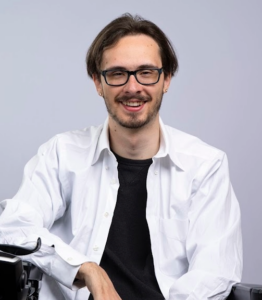
Major: Psychology, Art History
Personal Statement:
“The Lafayette Ideal is a well-rounded, educated member of the senior class who adds to a sound academic record noteworthy participation in college activities and student life, which contribute to the advancement of the College on and off campus. Academic brilliance or athletic prowess alone is not the criterion for selection a a Pepper Prize recipient.”
I’ve seen a significant culture shift, in my four years at Lafayette, from accessibility being considered a “theoretical good,” to inclusion now being acknowledged as a priority. As a highly-visible wheelchair user, I worked with students, accessibility services, facilities, the chief of finance, chief of staff, and President Hurd to advocate for greater accessibility initiatives, including functional door openers, ramps on buildings, wheelchair accessible paths, accessible signs/descriptions, and updating the college’s disability policies. I’ve even made an impact on Easton, with a few local establishments having added ramps to accommodate me. In less visible situations, I’ve seen minds and attitudes change during intimate conversations that focused on persevering through grief, oppressive systems, and difficult interpersonal dynamics. Many others have shared that I’ve shown them how to find joy in grim circumstances, understand people through a lens of empathy rather than sympathy, and identify and support others when they exhibit small signals indicating more severe stressors. I sustained my spinal cord injury just after graduating high school and had to defer for a year to recover. My activities were greatly limited that year, doctors and Medicaid advised against trying to attend Lafayette, and there were certainly times I became disillusioned. But once I managed to get here, I vowed to appreciate Lafayette to the fullest, believing the school shared my priorities of building connection through community and expanding one’s knowledge through global education and diverse activities. I’m now the first student at Lafayette and the School for International Training to study abroad as a wheelchair user. Many people assume that disabled people and wheelchair users live passive lives, but through my diverse interests, activities, and projects I’ve challenged these expectations and proved that severely disabled can and should be an important and productive part of Lafayette’s student body.
Question 1: Please elaborate on the activity or accomplishment that has been the most meaningful to you during your time at Lafayette and why?
True connection and understanding become possible when having one-on-one conversations. This is where trust, friendship, comfort, and care can begin, which is why I so passionately enjoyed being a Conversation PARDner for incoming international students. The transition to college is simultaneously incredibly exciting and terrifying, and it’s tremendously helpful to have support as one navigates new beginnings. During my two Study Abroad interim trips I looked forward to hopping on Zoom, even though it was sometimes at midnight, to chat with students about Lafayette and being a student in America. Though it may not be obvious, international students and those with disabilities share many common barriers: acclimating to unfamiliar environments, being restricted by legislative policies, etc. I broke down the first night of college because even on that first day I encountered numerous unanticipated obstacles that prevented me from fully engaging with others. Since then, I wanted to ensure that no other student who I spoke with felt as I did, and understood that they would be able to overcome great challenges. I will continue this journey of supporting others by beginning a master’s in International Education in the Fall.
Question 2: Please briefly describe any unique circumstances, highlights from your time at Lafayette, things you are proud of or other special considerations, anything that you feel is relevant to your consideration as a Pepper Prize applicant and that is not addressed elsewhere.
I was a performer and an athlete before my injury, but after my accident, I didn’t feel confident in my ability to be either of those things. My paralysis affects most of my chest, and affects my ability to breathe and use my muscles. I was quite weak when I started college, and felt pretty frail. My favorite part of being in theater was singing, but I didn’t expect myself to be able to have enough breath control to be able to manage performing a song. I took a shot, though, and set up meetings with the vocal professors here, and they told me that it could still be possible to sing. My first semester, I auditioned for the Chorduroys a cappella group on a whim, was accepted as a member, and began taking voice lessons. Over the years since, I’ve taken private voice lessons, performed with the Chorduroys, honed my sound and continued to better myself. I’ve had the opportunity to perform at open mic nights, ISA showcases, and had a solo at ICCAs. Lafayette didn’t just give me my voice back, it gave me my confidence back as well.